
What is ferritin?
Ferritin is the protein that stores iron in your body. A ferritin test does not measure the iron circulating in your blood right now. It measures your reserves, the iron you have banked, kind of like a savings account for a rainy day but of your iron stores.
That distinction matters for hair. You can have a perfectly normal hemoglobin, no anemia, no fatigue that anyone would call remarkable, and still be running your follicles on an overdrawn account.
What is ferritin face?
It is not a medical diagnosis. It’s a term to describe facial changes that people attribute to low ferritin.
Features include:
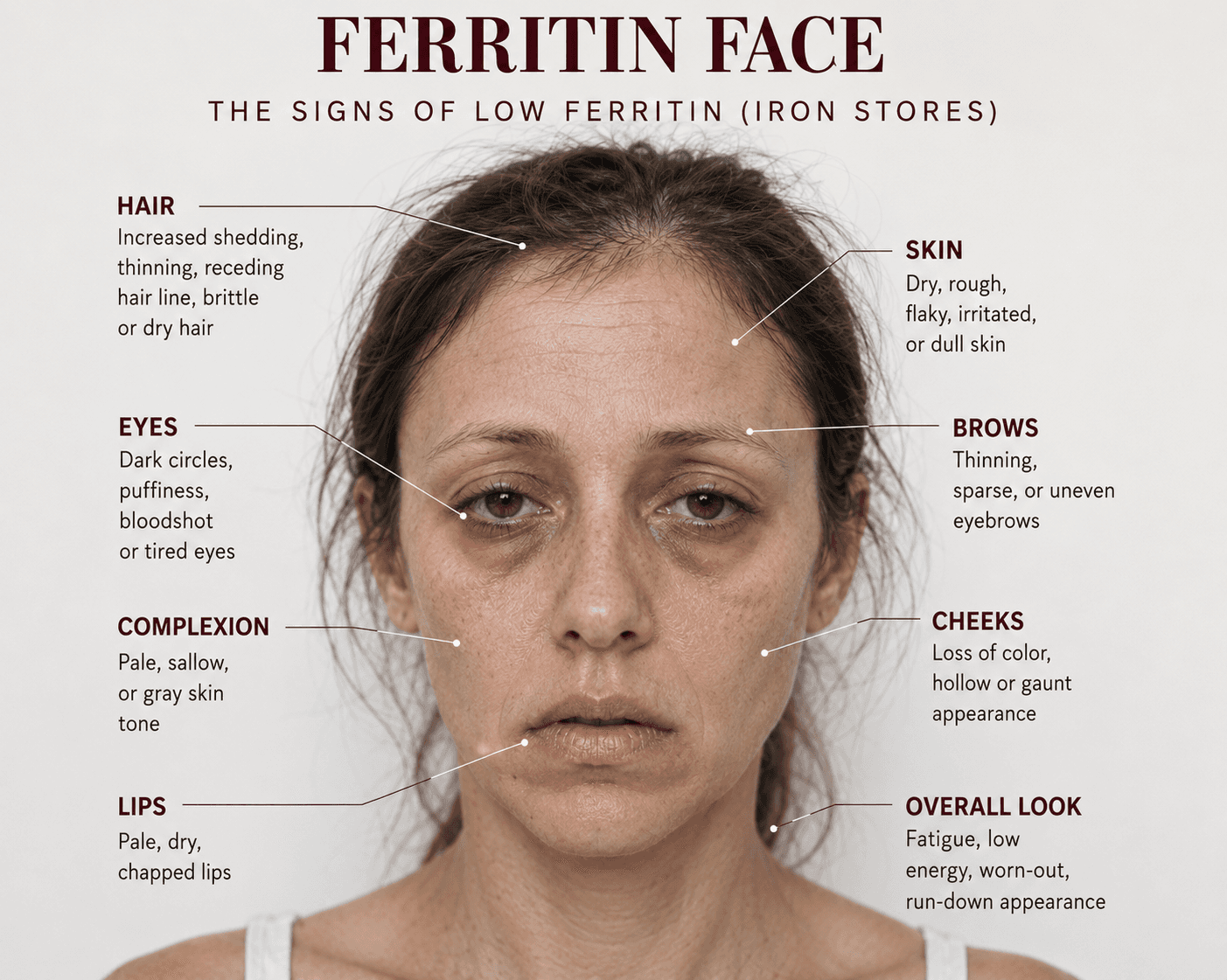
Dry, rough, flaky, irritated, and dull skin
Thinning sparse or uneven eyebrows
Loss of color & gaunt or hollow appearance of your cheeks
Overall fatigue, low energy, worn-out appearance
Increased hair shedding, thinning, receding hairline, brittle or dry hair
Dark circles, puffy under eyes, or bloodshot, tired eyes
Pale, sallow or gray complexion/ skin tone
Pale, dry, cracked chapped lips
As you can see, these are not very flattering characteristics. Iron helps your body work more efficiently. It helps you stay energized, it helps with healing, and it helps your hair grow and your skin glow. Without iron stores, a lot of mechanisms that are outside of the realm of pure survival are not firing on all cylinders so it deteriorates your looks as illustrated in the photo above.
What ferritin level causes hair loss and dry dull skin?
Here is how I frame it with patients:
Under 30 ng/mL. You’re depleted. This level of low ferritin isn’t just going to negatively affect your hair, it is bad for your skin, dark circles, nail brittleness, eyebrows falling out, fatigue, bad mood, poor immunity and healing times. If your ferritin is here, its time to fix it.
30 to 70 ng/mL. The gray zone. This is normal on paper, but it is not great for your looks or health. The goal is 70-- for hair growth and healthy skin.
Above 70 ng/mL. The range you want to hit for glowing skin and fully functioning hair growth.
Obviously this is just part of your picture of health and doesn’t tell us everything, for the full picture we look at your thyroid panel, your cycle, your diet, and your medication list too.
How to fix low ferritin?
If you are low in ferritin, start supplementing with 325mg Ferrous Sulfate. Also look to your diet to make sure you are getting adequate sources of iron. If you are vegan or vegetarian buy an iron fish to cook vegetables with (it is made out of cast iron, not fish). Oral iron also needs to be taken correctly to absorb at all, and the dosing your body tolerates is a clinical decision. You can take iron with vitamin c to help absorption. Heme iron (from red meat) is the best source of iron, it is the most bioavailable. If you are having a lot of trouble with getting iron from your diet and from supplementing we suggest you go see a hematologist, and ask for an iron infusion. Low ferritin is especially common among women because women lose blood during their periods, and often partake in restrictive diets.
Rebuilding iron stores takes months, not weeks, and the follicle needs a full cycle to respond after that.
Look at what emptied the tank. Heavy periods, restricted eating, plant-based diets without careful planning, GLP-1 medications that cut total food volume, gastric surgery, and undiagnosed gut conditions all deplete iron. Correcting the number without correcting the cause buys you a temporary win.
Why fixing your ferritin is not enough
Just because you are shedding from low ferritin, doesn’t mean that it was the sole cause of your hair loss. Causes of hair loss typically compound, so you may have also had iron depletion, a stressful year, a pregnancy, a hormonal fluctuation, a thyroid condition, a GLP-1 hair loss event, and maybe perimenopause. When you finally see the hair loss pattern emerge several causes are contributing to it, not just one.
The worst thing to do is to wait until you have all of the answers to start treatment. Waiting is the most expensive treatment option because you will lose more hair in the meantime.
Try Hair Cultivated to Treat your hair loss. Figure out the formula that would work best for you.
Where Hair Cultivated comes in
Once your labs are addressed, the question becomes whether your follicles need active support to rebuild density. That is what we built Hair Cultivated to do.
Our serum pairs 7.5 percent minoxidil with tretinoin. Minoxidil extends the growth phase and improves blood flow to the follicle. Tretinoin increases how much minoxidil the scalp absorbs, which is why the pairing outperforms minoxidil on its own. We formulate without propylene glycol or alcohols, the two ingredients responsible for most of the dryness, itching, and irritation women report with drugstore minoxidil. Our Dry Touch Finish™ means you apply it and go, without wrecking your blowout.
It is prescription strength, dosed for women, and formulated to feel like the rest of your beauty routine rather than a punishment.
We do not guarantee regrowth, and no one honest will. What we tell you is that consistent treatment gives your follicles their best shot, and that most women evaluate results at the 90-day mark.
Not sure what kind of hair loss you have? Take the quiz and get a read on what is driving your shedding, or download the Hair Growth Guide and start with the fundamentals.
Frequently asked questions
What ferritin level is too low for hair growth? Most labs flag ferritin below 10 to 15 ng/mL, but hair research suggests follicles struggle well above that. Under 30 ng/mL indicates depletion. Many clinicians treating active shedding target above 70 ng/mL.
Can low ferritin cause hair loss without anemia? Yes. Hemoglobin can stay normal while iron stores run low. Ferritin depletion often precedes anemia by a long stretch, and hair can respond during that window.
How long does hair take to grow back after correcting low ferritin? Rebuilding iron stores usually takes several months, and the follicle needs a full cycle after that before you see change. Most women assess progress at three to six months, not weeks.
Does taking iron regrow hair if my levels are normal? No, and it carries risk. Iron supplementation helps when stores are low. Taking iron without documented deficiency can cause accumulation and organ damage.
Should I test anything besides ferritin? Ask about a complete blood count, thyroid function, and vitamin D at minimum. Ferritin also rises with inflammation, so an inflammatory marker helps interpret a number that looks falsely reassuring.
This article is educational and is not a substitute for medical care.
What is ferritin?
Ferritin is the protein that stores iron in your body. A ferritin test does not measure the iron circulating in your blood right now. It measures your reserves, the iron you have banked, kind of like a savings account for a rainy day but of your iron stores.
That distinction matters for hair. You can have a perfectly normal hemoglobin, no anemia, no fatigue that anyone would call remarkable, and still be running your follicles on an overdrawn account.
What is ferritin face?
It is not a medical diagnosis. It’s a term to describe facial changes that people attribute to low ferritin.
Features include:
Dry, rough, flaky, irritated, and dull skin
Thinning sparse or uneven eyebrows
Loss of color & gaunt or hollow appearance of your cheeks
Overall fatigue, low energy, worn-out appearance
Increased hair shedding, thinning, receding hairline, brittle or dry hair
Dark circles, puffy under eyes, or bloodshot, tired eyes
Pale, sallow or gray complexion/ skin tone
Pale, dry, cracked chapped lips
As you can see, these are not very flattering characteristics. Iron helps your body work more efficiently. It helps you stay energized, it helps with healing, and it helps your hair grow and your skin glow. Without iron stores, a lot of mechanisms that are outside of the realm of pure survival are not firing on all cylinders so it deteriorates your looks as illustrated in the photo above.
What ferritin level causes hair loss and dry dull skin?
Here is how I frame it with patients:
Under 30 ng/mL. You’re depleted. This level of low ferritin isn’t just going to negatively affect your hair, it is bad for your skin, dark circles, nail brittleness, eyebrows falling out, fatigue, bad mood, poor immunity and healing times. If your ferritin is here, its time to fix it.
30 to 70 ng/mL. The gray zone. This is normal on paper, but it is not great for your looks or health. The goal is 70-- for hair growth and healthy skin.
Above 70 ng/mL. The range you want to hit for glowing skin and fully functioning hair growth.
Obviously this is just part of your picture of health and doesn’t tell us everything, for the full picture we look at your thyroid panel, your cycle, your diet, and your medication list too.
How to fix low ferritin?
If you are low in ferritin, start supplementing with 325mg Ferrous Sulfate. Also look to your diet to make sure you are getting adequate sources of iron. If you are vegan or vegetarian buy an iron fish to cook vegetables with (it is made out of cast iron, not fish). Oral iron also needs to be taken correctly to absorb at all, and the dosing your body tolerates is a clinical decision. You can take iron with vitamin c to help absorption. Heme iron (from red meat) is the best source of iron, it is the most bioavailable. If you are having a lot of trouble with getting iron from your diet and from supplementing we suggest you go see a hematologist, and ask for an iron infusion. Low ferritin is especially common among women because women lose blood during their periods, and often partake in restrictive diets.
Rebuilding iron stores takes months, not weeks, and the follicle needs a full cycle to respond after that.
Look at what emptied the tank. Heavy periods, restricted eating, plant-based diets without careful planning, GLP-1 medications that cut total food volume, gastric surgery, and undiagnosed gut conditions all deplete iron. Correcting the number without correcting the cause buys you a temporary win.
Why fixing your ferritin is not enough
Just because you are shedding from low ferritin, doesn’t mean that it was the sole cause of your hair loss. Causes of hair loss typically compound, so you may have also had iron depletion, a stressful year, a pregnancy, a hormonal fluctuation, a thyroid condition, a GLP-1 hair loss event, and maybe perimenopause. When you finally see the hair loss pattern emerge several causes are contributing to it, not just one.
The worst thing to do is to wait until you have all of the answers to start treatment. Waiting is the most expensive treatment option because you will lose more hair in the meantime.
Try Hair Cultivated to Treat your hair loss. Figure out the formula that would work best for you.
Where Hair Cultivated comes in
Once your labs are addressed, the question becomes whether your follicles need active support to rebuild density. That is what we built Hair Cultivated to do.
Our serum pairs 7.5 percent minoxidil with tretinoin. Minoxidil extends the growth phase and improves blood flow to the follicle. Tretinoin increases how much minoxidil the scalp absorbs, which is why the pairing outperforms minoxidil on its own. We formulate without propylene glycol or alcohols, the two ingredients responsible for most of the dryness, itching, and irritation women report with drugstore minoxidil. Our Dry Touch Finish™ means you apply it and go, without wrecking your blowout.
It is prescription strength, dosed for women, and formulated to feel like the rest of your beauty routine rather than a punishment.
We do not guarantee regrowth, and no one honest will. What we tell you is that consistent treatment gives your follicles their best shot, and that most women evaluate results at the 90-day mark.
Not sure what kind of hair loss you have? Take the quiz and get a read on what is driving your shedding, or download the Hair Growth Guide and start with the fundamentals.
Frequently asked questions
What ferritin level is too low for hair growth? Most labs flag ferritin below 10 to 15 ng/mL, but hair research suggests follicles struggle well above that. Under 30 ng/mL indicates depletion. Many clinicians treating active shedding target above 70 ng/mL.
Can low ferritin cause hair loss without anemia? Yes. Hemoglobin can stay normal while iron stores run low. Ferritin depletion often precedes anemia by a long stretch, and hair can respond during that window.
How long does hair take to grow back after correcting low ferritin? Rebuilding iron stores usually takes several months, and the follicle needs a full cycle after that before you see change. Most women assess progress at three to six months, not weeks.
Does taking iron regrow hair if my levels are normal? No, and it carries risk. Iron supplementation helps when stores are low. Taking iron without documented deficiency can cause accumulation and organ damage.
Should I test anything besides ferritin? Ask about a complete blood count, thyroid function, and vitamin D at minimum. Ferritin also rises with inflammation, so an inflammatory marker helps interpret a number that looks falsely reassuring.
This article is educational and is not a substitute for medical care.
ABOUT THE AUTHOR
Written by Dr. Kira Mengistu, MD — Harvard-trained physician and co-founder and Chief Medical Officer of Hair Cultivated. Dr. Mengistu experienced hair loss herself, and built Hair Cultivated to give women the clinical-grade treatment she couldn’t find.
Written by Dr. Kira Mengistu, MD — Harvard-trained physician and co-founder and Chief Medical Officer of Hair Cultivated. Dr. Mengistu experienced hair loss herself, and built Hair Cultivated to give women the clinical-grade treatment she couldn’t find.
