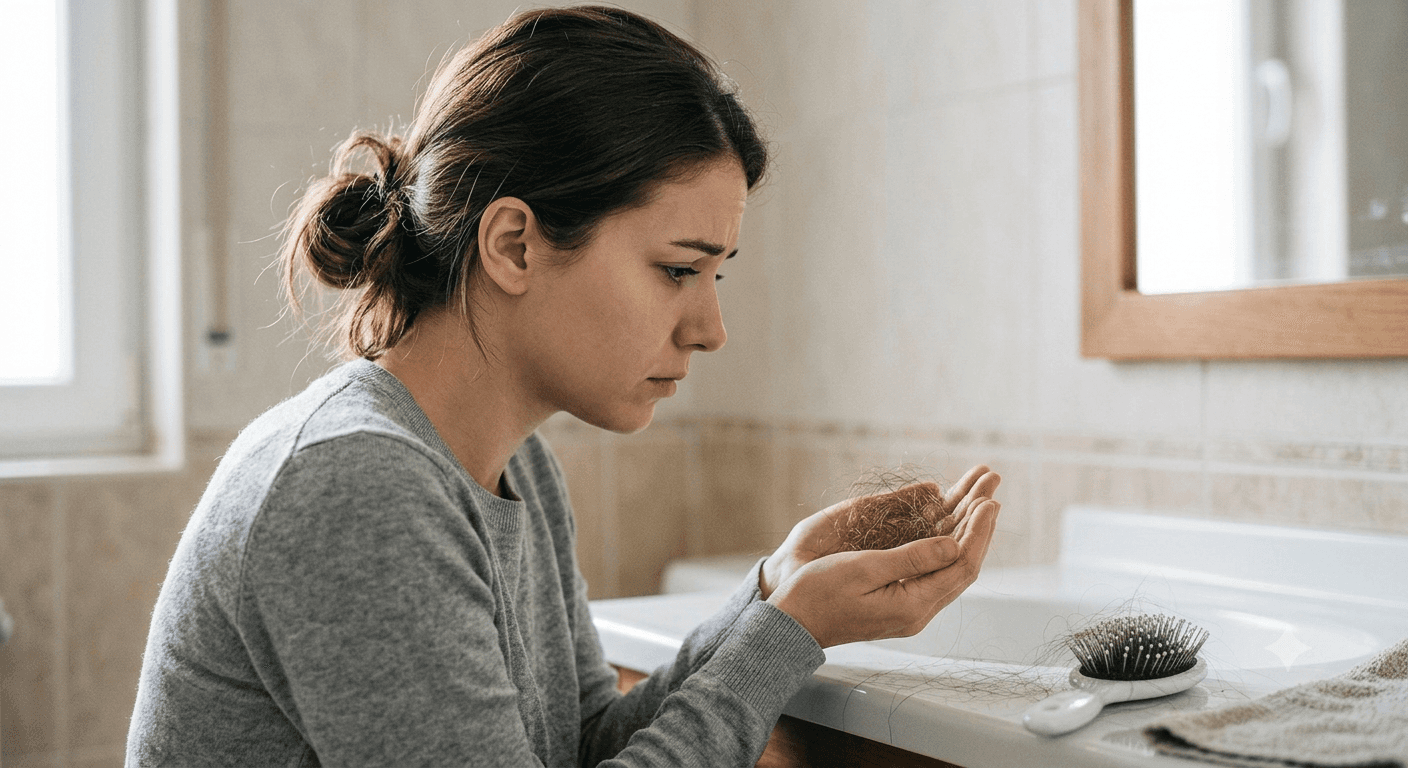
Most of my PCOS patients apologize before they get to the hair.
They lead with the periods, or the weight, or the fertility appointment. Then somewhere near the end, almost as an aside, they mention that their part is widening. And then they say the sentence I hear more than any other in this practice.
I know it’s just hair, but.
Let me take the “but” off the end of that.
What is actually happening with PCOS hair loss
Polycystic ovarian syndrome, now known as polycystic metabolic ovarian syndrome (PMOS), raises androgens. Androgens are the hormones your body has always made and, in this case, is now making more of, or responding to more strongly.
Your hair follicles are not uniform in how they answer that.
The follicles on your scalp, particularly along the part and the temples, are sensitive to androgens in a way that shrinks them. Each growth cycle produces a slightly finer, slightly shorter hair than the one before. The follicle does not die. It miniaturizes, which is a gradual and quiet process, and it is why you cannot point to the week it started.
The follicles on your chin, your upper lip, and your jawline answer the same signal in the opposite direction. They grow coarser and darker.
Same hormone. Same body. Opposite instructions, depending on where the follicle sits.
This is the part nobody says out loud, and it is the part that makes women feel like their body has turned on them personally. Roughly 65 to 75 percent of women with PCOS deal with excess hair growth. Somewhere between 20 and 30 percent deal with troublesome hair loss. A large number handle both at once, with a set of tweezers in one drawer and a root powder in the other.
You are not imagining the cruelty of that. It is a real physiologic phenomenon with a real explanation.
Why PCOS hair loss took this long to name
Two reasons.
The first is that hair loss is almost never the presenting complaint in PCOS. It usually arrives alongside irregular cycles, acne, or hirsutism, and those get the appointment time. In one dermatology series of 472 women presenting specifically for hair thinning, only 8 percent already had a PCOS diagnosis, and the clinic ended up referring additional women to a reproductive endocrinologist who had never been evaluated at all.
Read that from the other direction. Women were sitting in a hair loss clinic with an undiagnosed hormonal condition driving the hair loss.
The second reason is that it starts young. Some women show this pattern in their late teens and early twenties, which is an age where nobody, including most physicians, is looking for androgenetic thinning in a woman. So it gets called stress. Or postpartum. Or nothing at all.
Treat the underlying PCOS and the follicles directly. You must do both.
Three things follow from the mechanism, and they are the reason PCOS hair loss responds differently than a shed.
This is not telogen effluvium and it will not resolve on its own. A stress shed, a post-COVID shed, a GLP-1 shed, all of those are the follicle pausing. It restarts when the trigger clears. Androgen-driven miniaturization is the follicle shrinking, and it does not reverse by waiting. It progresses. The hair you still have is easier to hold than the hair you have to bring back, and that is not a scare tactic, it is the reason timing matters here more than in any other type.
Managing PCOS is not the same as treating the hair. Metformin, inositol, a good diet, weight change, birth control. These are worth doing and your endocrinologist should lead them. They address the hormonal environment. They do not directly restart a follicle that has already miniaturized. Those are two jobs and they need two tools.
Get the labs, and get the right ones. Total and free testosterone, DHEA-S, sex hormone binding globulin, and ferritin. That last one gets skipped constantly. Iron stores fall long before hemoglobin does, so a standard blood panel comes back normal while your follicles are working in a range they cannot function in. Ask for the number, not the summary.
Hair Cultivated has the best formula for treating PCOS hair loss and regrowing your hair
Topical minoxidil is the most evidenced tool for pushing miniaturized follicles back toward a productive growth cycle. We compound ours at 7.5%, among the highest topical concentrations available, and pair it with tretinoin, the prescription retinoid you likely already use on your face, which resurfaces the scalp and helps the minoxidil absorb.
Our base has no propylene glycol and no alcohols, so it does not dry out your ends or wreck a blowout. That sounds cosmetic. It is not. The treatment that works is the one you still use in month five, and women abandon greasy formulas by week three.
Download our hair growth guide to learn more about PCOS hair loss >>>

Dr. Kira Mengistu is a board-certified physician and co-founder of Hair Cultivated.
Educational only, not medical advice about your PCOS or any medication you take for it. Our treatments are not for use during pregnancy, while trying to conceive, or while breastfeeding. Individual results vary. We do not guarantee regrowth or specific timelines.
Most of my PCOS patients apologize before they get to the hair.
They lead with the periods, or the weight, or the fertility appointment. Then somewhere near the end, almost as an aside, they mention that their part is widening. And then they say the sentence I hear more than any other in this practice.
I know it’s just hair, but.
Let me take the “but” off the end of that.
What is actually happening with PCOS hair loss
Polycystic ovarian syndrome, now known as polycystic metabolic ovarian syndrome (PMOS), raises androgens. Androgens are the hormones your body has always made and, in this case, is now making more of, or responding to more strongly.
Your hair follicles are not uniform in how they answer that.
The follicles on your scalp, particularly along the part and the temples, are sensitive to androgens in a way that shrinks them. Each growth cycle produces a slightly finer, slightly shorter hair than the one before. The follicle does not die. It miniaturizes, which is a gradual and quiet process, and it is why you cannot point to the week it started.
The follicles on your chin, your upper lip, and your jawline answer the same signal in the opposite direction. They grow coarser and darker.
Same hormone. Same body. Opposite instructions, depending on where the follicle sits.
This is the part nobody says out loud, and it is the part that makes women feel like their body has turned on them personally. Roughly 65 to 75 percent of women with PCOS deal with excess hair growth. Somewhere between 20 and 30 percent deal with troublesome hair loss. A large number handle both at once, with a set of tweezers in one drawer and a root powder in the other.
You are not imagining the cruelty of that. It is a real physiologic phenomenon with a real explanation.
Why PCOS hair loss took this long to name
Two reasons.
The first is that hair loss is almost never the presenting complaint in PCOS. It usually arrives alongside irregular cycles, acne, or hirsutism, and those get the appointment time. In one dermatology series of 472 women presenting specifically for hair thinning, only 8 percent already had a PCOS diagnosis, and the clinic ended up referring additional women to a reproductive endocrinologist who had never been evaluated at all.
Read that from the other direction. Women were sitting in a hair loss clinic with an undiagnosed hormonal condition driving the hair loss.
The second reason is that it starts young. Some women show this pattern in their late teens and early twenties, which is an age where nobody, including most physicians, is looking for androgenetic thinning in a woman. So it gets called stress. Or postpartum. Or nothing at all.
Treat the underlying PCOS and the follicles directly. You must do both.
Three things follow from the mechanism, and they are the reason PCOS hair loss responds differently than a shed.
This is not telogen effluvium and it will not resolve on its own. A stress shed, a post-COVID shed, a GLP-1 shed, all of those are the follicle pausing. It restarts when the trigger clears. Androgen-driven miniaturization is the follicle shrinking, and it does not reverse by waiting. It progresses. The hair you still have is easier to hold than the hair you have to bring back, and that is not a scare tactic, it is the reason timing matters here more than in any other type.
Managing PCOS is not the same as treating the hair. Metformin, inositol, a good diet, weight change, birth control. These are worth doing and your endocrinologist should lead them. They address the hormonal environment. They do not directly restart a follicle that has already miniaturized. Those are two jobs and they need two tools.
Get the labs, and get the right ones. Total and free testosterone, DHEA-S, sex hormone binding globulin, and ferritin. That last one gets skipped constantly. Iron stores fall long before hemoglobin does, so a standard blood panel comes back normal while your follicles are working in a range they cannot function in. Ask for the number, not the summary.
Hair Cultivated has the best formula for treating PCOS hair loss and regrowing your hair
Topical minoxidil is the most evidenced tool for pushing miniaturized follicles back toward a productive growth cycle. We compound ours at 7.5%, among the highest topical concentrations available, and pair it with tretinoin, the prescription retinoid you likely already use on your face, which resurfaces the scalp and helps the minoxidil absorb.
Our base has no propylene glycol and no alcohols, so it does not dry out your ends or wreck a blowout. That sounds cosmetic. It is not. The treatment that works is the one you still use in month five, and women abandon greasy formulas by week three.
Download our hair growth guide to learn more about PCOS hair loss >>>
Dr. Kira Mengistu is a board-certified physician and co-founder of Hair Cultivated.
Educational only, not medical advice about your PCOS or any medication you take for it. Our treatments are not for use during pregnancy, while trying to conceive, or while breastfeeding. Individual results vary. We do not guarantee regrowth or specific timelines.
ABOUT THE AUTHOR
Written by Dr. Kira Mengistu, MD — Harvard-trained physician and co-founder and Chief Medical Officer of Hair Cultivated. Dr. Mengistu experienced hair loss herself, and built Hair Cultivated to give women the clinical-grade treatment she couldn’t find.
Written by Dr. Kira Mengistu, MD — Harvard-trained physician and co-founder and Chief Medical Officer of Hair Cultivated. Dr. Mengistu experienced hair loss herself, and built Hair Cultivated to give women the clinical-grade treatment she couldn’t find.