My part is widening. My ponytail feels thinner. I can see my scalp in photos.
If you are in your 40s and any of those sentences sound like yours, you are not imagining it. Perimenopause hair loss is one of the most common and least discussed changes women face in the decade before menopause. Up to half of women notice hair thinning during this transition. Almost none of them get a straight answer about why it happens or what treats it.
Here is the straight answer.
What Perimenopause Does to Your Hair
Perimenopause is the hormonal transition that begins for most women between 38 and 50. Estrogen and progesterone start to decline, and they do not decline politely. They fluctuate, drop, and rebound over several years.
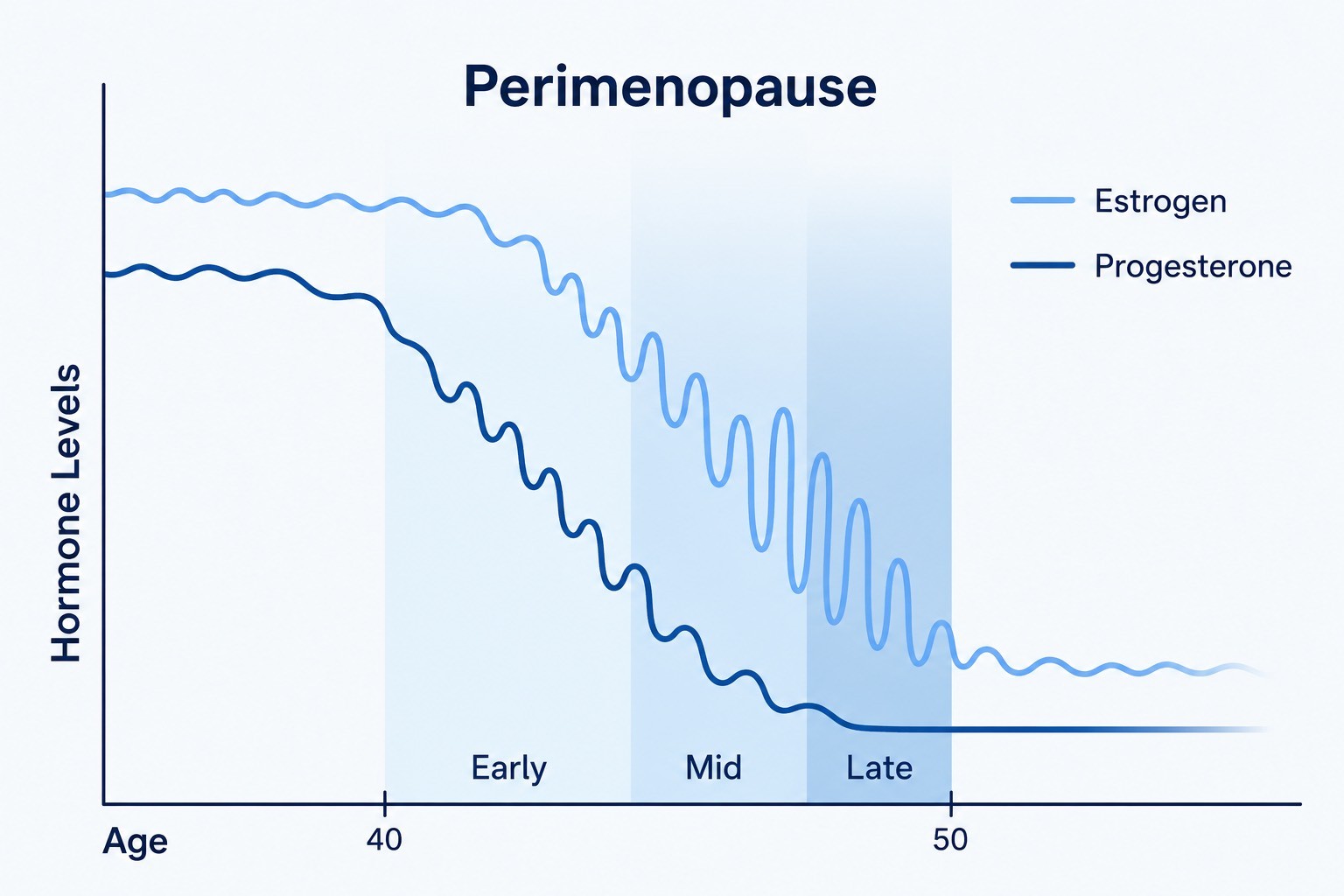
Your hair feels this before you do. Estrogen keeps hair in its growth phase longer. When estrogen falls, two things happen at once.
First, the growth phase of your hair cycle shortens. Each strand grows for less time before it sheds, so more hairs sit in the resting phase at any given moment. That is why your brush and shower drain look different than they did at 35.
Second, the balance shifts toward androgens, the hormones that drive female pattern hair loss. One of them, DHT, gradually shrinks sensitive follicles in a process called miniaturization. Each new hair grows in a little finer and a little shorter than the last. Individually the change is invisible. Across your whole part line, it looks like a widening part, a see-through ponytail, and thinning at the temples.
This is why perimenopause hair loss shows up as overall thinning rather than bald patches. The hair is still there. It is shrinking.
Why the Supplements Do Not Work For Perimenopause
Most women in perimenopause start where the beauty industry tells them to start. Biotin gummies. Collagen. Thickening shampoo. Nutrafol for nine months at $100 a month.
Those products fail for a simple reason. Perimenopause hair loss is hormonal and follicular, and supplements do not reach either mechanism at meaningful strength. A gummy cannot lengthen your growth phase. A shampoo sits on your hair shaft for 90 seconds and rinses away. Unless you have a true deficiency, more biotin does not translate to more hair.
You did not fail those products. Those products were never built for this problem.
What Treats Perimenopause Hair Loss
“Perimenopause hair loss responds to treatment,” says Dr. Kira Mengistu, board certified physician and Chief Medical Officer of Hair Cultivated. “Follicles that miniaturize are still alive. When we treat them with prescription strength ingredients and support the scalp itself, we give them the conditions to produce thicker hair again. The women who see the best results start early and stay consistent through the full 90 days.”
The treatments with the strongest evidence for female pattern hair loss and hormonal thinning are prescription strength, and they work at the follicle level.
Minoxidil, dosed for women. Minoxidil extends the growth phase and increases blood flow to the follicle, which pushes miniaturized hairs to grow back thicker. Most over-the-counter women’s minoxidil is 2% or 5%, in drying alcohol bases designed decades ago for men. The Hair Cultivated serum is 7.5% minoxidil, compounded with no propylene glycol and no drying alcohols, so it treats your scalp without wrecking your blowout.
Tretinoin, the retinoid you already trust. You started retinol before wrinkles. Your scalp deserves the same logic. In our serum, tretinoin increases skin cell turnover and helps minoxidil absorb where it needs to work. It is one half of how you anti-age your scalp instead of just covering the evidence.
Topical DHT blockers. For women whose thinning is driven by androgen sensitivity, a physician can add topical dutasteride, which blocks DHT at the follicle. Important: dutasteride must never be used by women who are pregnant, trying to conceive, or breastfeeding. Your prescribing physician will review whether it is appropriate for you.
This is the difference between a beauty product and Beauty Meets Medicine. One is a texture. The other is a treatment with a texture you will enjoy using. The Dry Touch Finish means no grease, no residue, and no disruption to how you style your hair.
The 90 Day Timeline For Hair Growth
Hair grows in cycles, and cycles take time. Here is what a realistic timeline looks like on prescription treatment.
Weeks 1 to 4. Nothing visible yet. Your follicles are responding beneath the surface. Some women notice a temporary uptick in shedding around week 2 to 6, often called the dread shed. It is a sign the treatment is cycling out old resting hairs to make room for new growth, it is temporary, and it is the single most common reason women quit right before results arrive. Trust the process.
Weeks 5 to 8. Shedding slows. Baby hairs begin appearing at the part line and temples.
Weeks 9 to 12 and beyond. New growth becomes visible in photos. Density improves. Most women see thicker, fuller hair in 90 days, and results continue building through months 4 to 6.
Johanna, one of our patients in her mid 40s, put it this way. “Being mid 40s and already having thin hair is not cute. I am so glad there is a science-backed product out there to help me out. My hair already feels thicker and healthier.”
Results vary. Individual outcomes depend on the cause and duration of hair loss.
Not Sure If This Is Perimenopause? Take the Quiz
Hair change in your 40s can come from more than one direction. Hormones, stress, iron levels, and thyroid function can all overlap. Our Hair Age Score quiz asks the questions a hair loss physician would ask and tells you whether your hair is aging faster than you are. It takes two minutes and gives you a clear starting point before you spend another dollar on products.
What Prescription Treatment Costs
Prescription hair care costs more than a bottle of shampoo, and it should. You are paying for a physician consultation, a formula compounded for your specific situation, and ingredients at strengths no store shelf carries. Compare it to what you already invest in your skin. Retinol, a facial, a single syringe of filler. Your hair frames every one of those results.
Hair Cultivated accepts FSA payment and offers Klarna.
Check out our amazing results HERE.
Results vary.
Frequently Asked Questions
Does perimenopause hair loss grow back?
Often, yes, with treatment. Miniaturized follicles are shrunken, not dead, and they can respond to prescription minoxidil by producing thicker hairs again. The earlier you treat, the more follicles you protect. Hair loss left untreated for many years becomes harder to reverse, which is why treating a widening part now matters more than waiting for it to get worse.
Is it perimenopause hair loss or female pattern hair loss?
Frequently both. Perimenopause is often the trigger that unmasks an underlying sensitivity to DHT, which is female pattern hair loss (the medical term is androgenic alopecia). The declining estrogen of perimenopause removes the protection your follicles had. A telehealth consultation with a physician can sort out your specific drivers, including whether labs for iron, thyroid, or hormones make sense.
Can I use minoxidil during perimenopause?
Yes. Minoxidil is the most studied treatment for hair thinning in women and is effective for hormonal hair loss. The formulation matters. Higher strength, a non-drying base, and pairing with tretinoin improve both results and the experience of using it daily. Do not use minoxidil or dutasteride if you are pregnant or trying to conceive.
How long does perimenopause hair loss last?
Without treatment, hormonal thinning tends to progress gradually through perimenopause and beyond menopause. With treatment, most women see shedding slow within the first two months and visible new growth around the 90 day mark, with continued improvement while treatment continues.
What vitamins help perimenopause hair loss?
Vitamins only help if you have a deficiency, most commonly low ferritin or vitamin D. They support hair health but do not treat the hormonal mechanism behind perimenopause thinning. If you have taken supplements for months with no change, the next step is prescription treatment, not another supplement.
Your Hair Is Not Done. It Is Waiting for the Right Treatment.
You anti-age your skin every night. Your scalp ages faster, and it responds to the same category of care, medical grade ingredients in a formula you will enjoy using.
Start with a two minute consultation. A physician reviews your history, your photos, and your goals, then formulates your prescription. It ships to your door, and your care team stays with you through every phase of the treatment.
My part is widening. My ponytail feels thinner. I can see my scalp in photos.
If you are in your 40s and any of those sentences sound like yours, you are not imagining it. Perimenopause hair loss is one of the most common and least discussed changes women face in the decade before menopause. Up to half of women notice hair thinning during this transition. Almost none of them get a straight answer about why it happens or what treats it.
Here is the straight answer.
What Perimenopause Does to Your Hair
Perimenopause is the hormonal transition that begins for most women between 38 and 50. Estrogen and progesterone start to decline, and they do not decline politely. They fluctuate, drop, and rebound over several years.
Your hair feels this before you do. Estrogen keeps hair in its growth phase longer. When estrogen falls, two things happen at once.
First, the growth phase of your hair cycle shortens. Each strand grows for less time before it sheds, so more hairs sit in the resting phase at any given moment. That is why your brush and shower drain look different than they did at 35.
Second, the balance shifts toward androgens, the hormones that drive female pattern hair loss. One of them, DHT, gradually shrinks sensitive follicles in a process called miniaturization. Each new hair grows in a little finer and a little shorter than the last. Individually the change is invisible. Across your whole part line, it looks like a widening part, a see-through ponytail, and thinning at the temples.
This is why perimenopause hair loss shows up as overall thinning rather than bald patches. The hair is still there. It is shrinking.
Why the Supplements Do Not Work For Perimenopause
Most women in perimenopause start where the beauty industry tells them to start. Biotin gummies. Collagen. Thickening shampoo. Nutrafol for nine months at $100 a month.
Those products fail for a simple reason. Perimenopause hair loss is hormonal and follicular, and supplements do not reach either mechanism at meaningful strength. A gummy cannot lengthen your growth phase. A shampoo sits on your hair shaft for 90 seconds and rinses away. Unless you have a true deficiency, more biotin does not translate to more hair.
You did not fail those products. Those products were never built for this problem.
What Treats Perimenopause Hair Loss
“Perimenopause hair loss responds to treatment,” says Dr. Kira Mengistu, board certified physician and Chief Medical Officer of Hair Cultivated. “Follicles that miniaturize are still alive. When we treat them with prescription strength ingredients and support the scalp itself, we give them the conditions to produce thicker hair again. The women who see the best results start early and stay consistent through the full 90 days.”
The treatments with the strongest evidence for female pattern hair loss and hormonal thinning are prescription strength, and they work at the follicle level.
Minoxidil, dosed for women. Minoxidil extends the growth phase and increases blood flow to the follicle, which pushes miniaturized hairs to grow back thicker. Most over-the-counter women’s minoxidil is 2% or 5%, in drying alcohol bases designed decades ago for men. The Hair Cultivated serum is 7.5% minoxidil, compounded with no propylene glycol and no drying alcohols, so it treats your scalp without wrecking your blowout.
Tretinoin, the retinoid you already trust. You started retinol before wrinkles. Your scalp deserves the same logic. In our serum, tretinoin increases skin cell turnover and helps minoxidil absorb where it needs to work. It is one half of how you anti-age your scalp instead of just covering the evidence.
Topical DHT blockers. For women whose thinning is driven by androgen sensitivity, a physician can add topical dutasteride, which blocks DHT at the follicle. Important: dutasteride must never be used by women who are pregnant, trying to conceive, or breastfeeding. Your prescribing physician will review whether it is appropriate for you.
This is the difference between a beauty product and Beauty Meets Medicine. One is a texture. The other is a treatment with a texture you will enjoy using. The Dry Touch Finish means no grease, no residue, and no disruption to how you style your hair.
The 90 Day Timeline For Hair Growth
Hair grows in cycles, and cycles take time. Here is what a realistic timeline looks like on prescription treatment.
Weeks 1 to 4. Nothing visible yet. Your follicles are responding beneath the surface. Some women notice a temporary uptick in shedding around week 2 to 6, often called the dread shed. It is a sign the treatment is cycling out old resting hairs to make room for new growth, it is temporary, and it is the single most common reason women quit right before results arrive. Trust the process.
Weeks 5 to 8. Shedding slows. Baby hairs begin appearing at the part line and temples.
Weeks 9 to 12 and beyond. New growth becomes visible in photos. Density improves. Most women see thicker, fuller hair in 90 days, and results continue building through months 4 to 6.
Johanna, one of our patients in her mid 40s, put it this way. “Being mid 40s and already having thin hair is not cute. I am so glad there is a science-backed product out there to help me out. My hair already feels thicker and healthier.”
Results vary. Individual outcomes depend on the cause and duration of hair loss.
Not Sure If This Is Perimenopause? Take the Quiz
Hair change in your 40s can come from more than one direction. Hormones, stress, iron levels, and thyroid function can all overlap. Our Hair Age Score quiz asks the questions a hair loss physician would ask and tells you whether your hair is aging faster than you are. It takes two minutes and gives you a clear starting point before you spend another dollar on products.
What Prescription Treatment Costs
Prescription hair care costs more than a bottle of shampoo, and it should. You are paying for a physician consultation, a formula compounded for your specific situation, and ingredients at strengths no store shelf carries. Compare it to what you already invest in your skin. Retinol, a facial, a single syringe of filler. Your hair frames every one of those results.
Hair Cultivated accepts FSA payment and offers Klarna.
Check out our amazing results HERE.
Results vary.
Frequently Asked Questions
Does perimenopause hair loss grow back?
Often, yes, with treatment. Miniaturized follicles are shrunken, not dead, and they can respond to prescription minoxidil by producing thicker hairs again. The earlier you treat, the more follicles you protect. Hair loss left untreated for many years becomes harder to reverse, which is why treating a widening part now matters more than waiting for it to get worse.
Is it perimenopause hair loss or female pattern hair loss?
Frequently both. Perimenopause is often the trigger that unmasks an underlying sensitivity to DHT, which is female pattern hair loss (the medical term is androgenic alopecia). The declining estrogen of perimenopause removes the protection your follicles had. A telehealth consultation with a physician can sort out your specific drivers, including whether labs for iron, thyroid, or hormones make sense.
Can I use minoxidil during perimenopause?
Yes. Minoxidil is the most studied treatment for hair thinning in women and is effective for hormonal hair loss. The formulation matters. Higher strength, a non-drying base, and pairing with tretinoin improve both results and the experience of using it daily. Do not use minoxidil or dutasteride if you are pregnant or trying to conceive.
How long does perimenopause hair loss last?
Without treatment, hormonal thinning tends to progress gradually through perimenopause and beyond menopause. With treatment, most women see shedding slow within the first two months and visible new growth around the 90 day mark, with continued improvement while treatment continues.
What vitamins help perimenopause hair loss?
Vitamins only help if you have a deficiency, most commonly low ferritin or vitamin D. They support hair health but do not treat the hormonal mechanism behind perimenopause thinning. If you have taken supplements for months with no change, the next step is prescription treatment, not another supplement.
Your Hair Is Not Done. It Is Waiting for the Right Treatment.
You anti-age your skin every night. Your scalp ages faster, and it responds to the same category of care, medical grade ingredients in a formula you will enjoy using.
Start with a two minute consultation. A physician reviews your history, your photos, and your goals, then formulates your prescription. It ships to your door, and your care team stays with you through every phase of the treatment.
ABOUT THE AUTHOR
Written by Dr. Kira Mengistu, MD — Harvard-trained physician and co-founder and Chief Medical Officer of Hair Cultivated. Dr. Mengistu experienced hair loss herself, and built Hair Cultivated to give women the clinical-grade treatment she couldn’t find.
Written by Dr. Kira Mengistu, MD — Harvard-trained physician and co-founder and Chief Medical Officer of Hair Cultivated. Dr. Mengistu experienced hair loss herself, and built Hair Cultivated to give women the clinical-grade treatment she couldn’t find.