
You have done this before. You started tretinoin or retinol, and for six weeks your skin looked worse. Breakouts surfaced, texture went strange, and you stood in front of the mirror wondering why you paid for this. Your dermatologist told you to keep going. You did. Then your skin turned the corner and you never looked back.
The minoxidil purge is the same story, told one inch higher.
The conversation I have most often with new patients happens somewhere between week two and week eight of treatment. She noticed more hair in the brush and the drain, and she is ready to quit. It has a nickname, the dread shed, and it is the single most common reason women stop hair loss treatment right before it starts working. We wrote a full fact-versus-fiction guide on the dread shed here. This article covers something different: the mechanism, and why the clinical logic you already trust for your face applies directly to your scalp.
Why retinoids make skin worse before better
Retinoids accelerate epidermal turnover. Tretinoin binds retinoic acid receptors in your keratinocytes and speeds the rate at which skin cells mature, rise, and shed. In the first weeks, comedones and congestion that were forming quietly beneath the surface get pushed up and out on a compressed schedule. Dermatologists call this retinization, or more casually, the purge, and we draw a clean clinical line between purging and an adverse reaction. A purge is the treatment doing its job faster than the surface can hide it. A reaction is inflammation the treatment is causing.
You accepted that distinction when you started retinol. You understood that visible worsening was a stage of improvement, not evidence against it. That mental model is the exact one your scalp needs from you now.
What minoxidil does to a resting follicle
Every follicle cycles through three phases: anagen, the active growth phase that lasts years, telogen, a resting phase lasting roughly three months, and exogen, the release of the finished hair. In androgenetic alopecia and most shedding conditions, the ratio tilts wrong. Too many follicles sit parked in telogen, each holding a retired club hair that stopped growing months ago.
Minoxidil shortens telogen and prompts resting follicles to re-enter anagen early (Messenger and Rundegren, 2004). Pharmacologically it acts as a potassium channel opener at the follicle, improving perifollicular blood flow and stimulating the dermal papilla, the cluster of cells at the follicle base that directs the growth cycle. Here is the part nobody explains at the pharmacy counter. A follicle cannot build a new anagen hair while the old club hair occupies the canal. Re-entry into growth begins with release. The new shaft forming below physically displaces the retired hair above it.
Multiply that across thousands of follicles re-entering anagen on a similar schedule and you get the purge. The hairs in your drain completed their growth months ago. They were anchored loosely, waiting for exogen. Minoxidil moved up the timeline, synchronized it, and made it visible all at once, which is exactly what a medication that reactivates follicles should do.

The retinol parallel is not a loose metaphor. Both are accelerated turnover in a keratinized structure. The clearing of the old is visible before the arrival of the new, and the clearing is the first measurable sign the tissue responded.
The purge is the sorting
Examine the hairs that shed during this phase and a pattern often emerges. Many are fine, short, and lightly pigmented. These are miniaturized hairs, the progressively weaker output of follicles under androgen pressure. When a miniaturized follicle re-enters anagen under treatment, it releases its weakest product first.
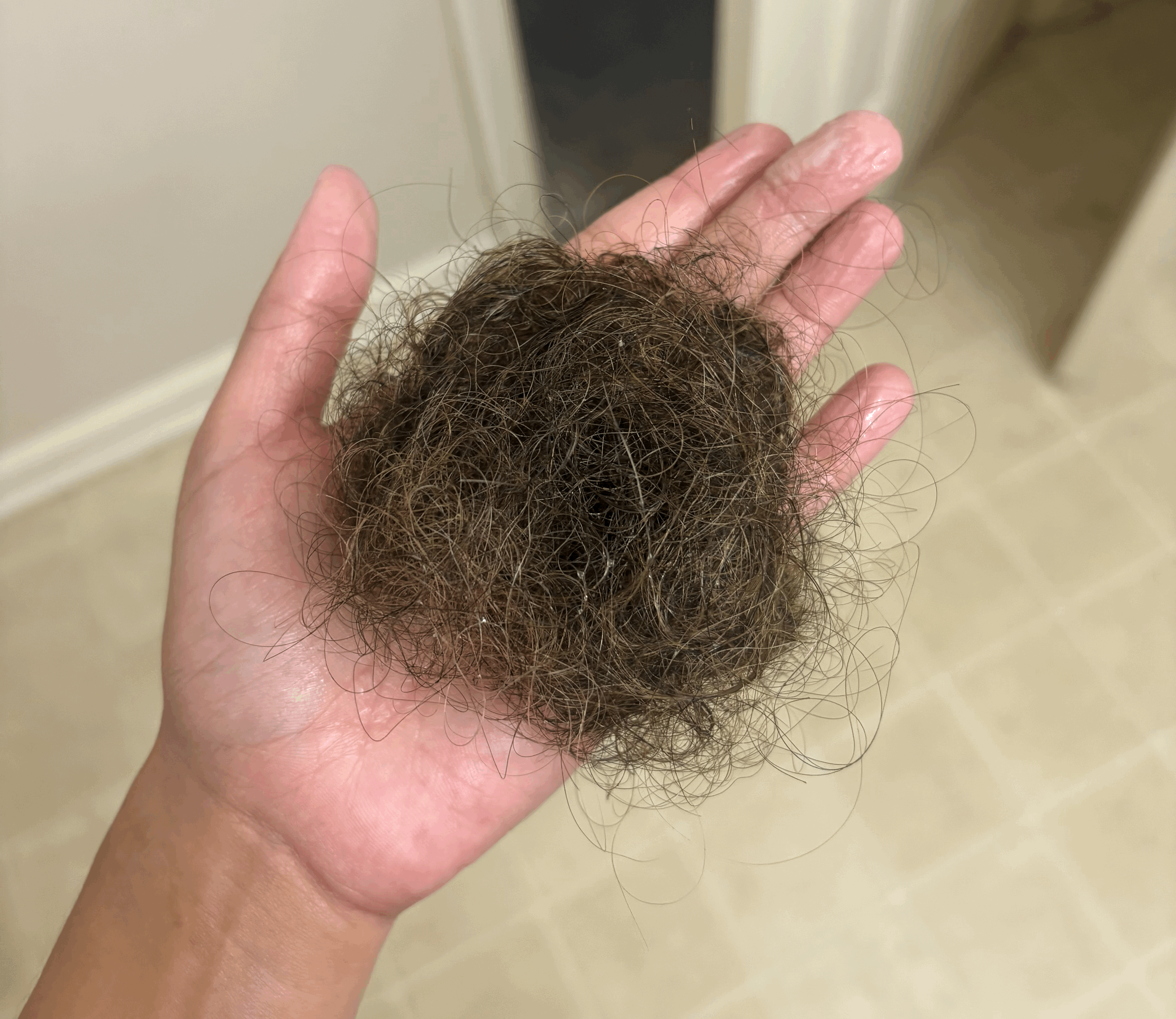
That reframe matters clinically and psychologically. The purge is not your hair loss accelerating. It is your follicles retiring their failing inventory to rebuild. What grows in its place, with continued treatment, is a terminal hair from a follicle now cycling in growth mode rather than decline.
This is why discontinuing during the purge is the most expensive mistake in hair loss treatment. You absorb the clearing cost, then leave before the rebuild. The women who see thicker, fuller hair in 90 days are the ones who trust the process through weeks two through eight, the same way they trusted retinization through week four.
Purge or problem: the clinical distinction
I give scalp patients the same structure dermatology gives skin patients for separating an expected purge from a reaction that needs attention.
Consistent with the purge:
Shedding began two to eight weeks after starting treatment
Shed hairs skew fine and short rather than long and terminal
The scalp itself feels normal, without pain, burning, or spreading redness
Shedding rises, plateaus, and tapers over several weeks
Contact your prescriber if:
The application area is red, itchy, scaling, or irritated
Shedding continues to escalate well past the expected window
Loss appears in discrete patches rather than diffuse thinning, which points away from androgenetic alopecia and toward conditions that need separate evaluation
Formulation sits at the center of this distinction more than most patients realize. Drugstore minoxidil is commonly suspended in propylene glycol and alcohols, two of the most frequent culprits in irritant contact dermatitis of the scalp. An irritated scalp blurs the line between a normal purge and a vehicle your skin is rejecting, and I have watched that ambiguity push patients to quit a medication that was working. Our serum leaves both out, in a base built for women, so what you experience is the medicine, not the vehicle.
The tretinoin connection
Here the retinol logic closes its loop. Tretinoin is not only the analogy in this article. It is an ingredient in our serum, paired with 7.5% minoxidil.
Tretinoin acts on the follicle the way it acts on facial skin, accelerating cellular turnover, and it enhances penetration of the minoxidil applied alongside it, helping the active reach follicular depth instead of resting on the surface. The molecule you trusted through your skin purge is part of what makes your scalp treatment reach its target.
So when the purge arrives, you are not guessing whether worse means better. You are watching a mechanism you have already lived through once, driven in part by an ingredient you already know.
What I tell patients to do while the dread shed happens
Keep applying, every day. The purge resolves through treatment, not around it. Stopping mid-shed forfeits the clearing you already paid for.
Stop counting drain hairs. The drain measures the clear-out, not your future density. Photograph your part in consistent light once a month instead. Density changes show there first.
Mark eight weeks on your calendar. Give the purge a defined endpoint. Anxiety compounds on open-ended timelines.
Wash normally. Skipping washes only stockpiles shed hairs for a more dramatic reveal later, and a clean scalp supports everything the treatment is doing.
Her skin got worse before it got better, and she kept going. You already know how this story ends. Trust the process, and let your scalp catch up to what your skincare routine figured out years ago.
Frequently asked questions
How long does the minoxidil purge last? Shedding typically begins two to eight weeks after starting treatment and tapers over the following weeks as follicles transition into anagen. Individual timelines vary, which is one reason physician-guided treatment beats interpreting the drain alone.
Does minoxidil shedding mean it is working? Increased shedding in the early weeks is consistent with the medication doing its job. Minoxidil prompts resting follicles to re-enter the growth phase, and each reactivated follicle releases its retired hair to make room for the new shaft forming beneath it.
Should I stop minoxidil if my hair is shedding? Not for expected early shedding. Stopping mid-purge means absorbing the shed without the regrowth that follows. If shedding comes with scalp irritation, escalates well beyond the expected window, or appears in patches, contact your prescriber rather than quitting on your own.
Is the minoxidil purge the same as the dread shed? Yes, dread shed is the popular nickname for the same early shedding phase. Our complete guide separating dread shed fact from fiction covers the myths in depth.
References
Messenger AG, Rundegren J. Minoxidil: mechanisms of action on hair growth. British Journal of Dermatology. 2004;150(2):186-194. PMID: 14996087.
You have done this before. You started tretinoin or retinol, and for six weeks your skin looked worse. Breakouts surfaced, texture went strange, and you stood in front of the mirror wondering why you paid for this. Your dermatologist told you to keep going. You did. Then your skin turned the corner and you never looked back.
The minoxidil purge is the same story, told one inch higher.
The conversation I have most often with new patients happens somewhere between week two and week eight of treatment. She noticed more hair in the brush and the drain, and she is ready to quit. It has a nickname, the dread shed, and it is the single most common reason women stop hair loss treatment right before it starts working. We wrote a full fact-versus-fiction guide on the dread shed here. This article covers something different: the mechanism, and why the clinical logic you already trust for your face applies directly to your scalp.
Why retinoids make skin worse before better
Retinoids accelerate epidermal turnover. Tretinoin binds retinoic acid receptors in your keratinocytes and speeds the rate at which skin cells mature, rise, and shed. In the first weeks, comedones and congestion that were forming quietly beneath the surface get pushed up and out on a compressed schedule. Dermatologists call this retinization, or more casually, the purge, and we draw a clean clinical line between purging and an adverse reaction. A purge is the treatment doing its job faster than the surface can hide it. A reaction is inflammation the treatment is causing.
You accepted that distinction when you started retinol. You understood that visible worsening was a stage of improvement, not evidence against it. That mental model is the exact one your scalp needs from you now.
What minoxidil does to a resting follicle
Every follicle cycles through three phases: anagen, the active growth phase that lasts years, telogen, a resting phase lasting roughly three months, and exogen, the release of the finished hair. In androgenetic alopecia and most shedding conditions, the ratio tilts wrong. Too many follicles sit parked in telogen, each holding a retired club hair that stopped growing months ago.
Minoxidil shortens telogen and prompts resting follicles to re-enter anagen early (Messenger and Rundegren, 2004). Pharmacologically it acts as a potassium channel opener at the follicle, improving perifollicular blood flow and stimulating the dermal papilla, the cluster of cells at the follicle base that directs the growth cycle. Here is the part nobody explains at the pharmacy counter. A follicle cannot build a new anagen hair while the old club hair occupies the canal. Re-entry into growth begins with release. The new shaft forming below physically displaces the retired hair above it.
Multiply that across thousands of follicles re-entering anagen on a similar schedule and you get the purge. The hairs in your drain completed their growth months ago. They were anchored loosely, waiting for exogen. Minoxidil moved up the timeline, synchronized it, and made it visible all at once, which is exactly what a medication that reactivates follicles should do.
The retinol parallel is not a loose metaphor. Both are accelerated turnover in a keratinized structure. The clearing of the old is visible before the arrival of the new, and the clearing is the first measurable sign the tissue responded.
The purge is the sorting
Examine the hairs that shed during this phase and a pattern often emerges. Many are fine, short, and lightly pigmented. These are miniaturized hairs, the progressively weaker output of follicles under androgen pressure. When a miniaturized follicle re-enters anagen under treatment, it releases its weakest product first.
That reframe matters clinically and psychologically. The purge is not your hair loss accelerating. It is your follicles retiring their failing inventory to rebuild. What grows in its place, with continued treatment, is a terminal hair from a follicle now cycling in growth mode rather than decline.
This is why discontinuing during the purge is the most expensive mistake in hair loss treatment. You absorb the clearing cost, then leave before the rebuild. The women who see thicker, fuller hair in 90 days are the ones who trust the process through weeks two through eight, the same way they trusted retinization through week four.
Purge or problem: the clinical distinction
I give scalp patients the same structure dermatology gives skin patients for separating an expected purge from a reaction that needs attention.
Consistent with the purge:
Shedding began two to eight weeks after starting treatment
Shed hairs skew fine and short rather than long and terminal
The scalp itself feels normal, without pain, burning, or spreading redness
Shedding rises, plateaus, and tapers over several weeks
Contact your prescriber if:
The application area is red, itchy, scaling, or irritated
Shedding continues to escalate well past the expected window
Loss appears in discrete patches rather than diffuse thinning, which points away from androgenetic alopecia and toward conditions that need separate evaluation
Formulation sits at the center of this distinction more than most patients realize. Drugstore minoxidil is commonly suspended in propylene glycol and alcohols, two of the most frequent culprits in irritant contact dermatitis of the scalp. An irritated scalp blurs the line between a normal purge and a vehicle your skin is rejecting, and I have watched that ambiguity push patients to quit a medication that was working. Our serum leaves both out, in a base built for women, so what you experience is the medicine, not the vehicle.
The tretinoin connection
Here the retinol logic closes its loop. Tretinoin is not only the analogy in this article. It is an ingredient in our serum, paired with 7.5% minoxidil.
Tretinoin acts on the follicle the way it acts on facial skin, accelerating cellular turnover, and it enhances penetration of the minoxidil applied alongside it, helping the active reach follicular depth instead of resting on the surface. The molecule you trusted through your skin purge is part of what makes your scalp treatment reach its target.
So when the purge arrives, you are not guessing whether worse means better. You are watching a mechanism you have already lived through once, driven in part by an ingredient you already know.
What I tell patients to do while the dread shed happens
Keep applying, every day. The purge resolves through treatment, not around it. Stopping mid-shed forfeits the clearing you already paid for.
Stop counting drain hairs. The drain measures the clear-out, not your future density. Photograph your part in consistent light once a month instead. Density changes show there first.
Mark eight weeks on your calendar. Give the purge a defined endpoint. Anxiety compounds on open-ended timelines.
Wash normally. Skipping washes only stockpiles shed hairs for a more dramatic reveal later, and a clean scalp supports everything the treatment is doing.
Her skin got worse before it got better, and she kept going. You already know how this story ends. Trust the process, and let your scalp catch up to what your skincare routine figured out years ago.
Frequently asked questions
How long does the minoxidil purge last? Shedding typically begins two to eight weeks after starting treatment and tapers over the following weeks as follicles transition into anagen. Individual timelines vary, which is one reason physician-guided treatment beats interpreting the drain alone.
Does minoxidil shedding mean it is working? Increased shedding in the early weeks is consistent with the medication doing its job. Minoxidil prompts resting follicles to re-enter the growth phase, and each reactivated follicle releases its retired hair to make room for the new shaft forming beneath it.
Should I stop minoxidil if my hair is shedding? Not for expected early shedding. Stopping mid-purge means absorbing the shed without the regrowth that follows. If shedding comes with scalp irritation, escalates well beyond the expected window, or appears in patches, contact your prescriber rather than quitting on your own.
Is the minoxidil purge the same as the dread shed? Yes, dread shed is the popular nickname for the same early shedding phase. Our complete guide separating dread shed fact from fiction covers the myths in depth.
References
Messenger AG, Rundegren J. Minoxidil: mechanisms of action on hair growth. British Journal of Dermatology. 2004;150(2):186-194. PMID: 14996087.
ABOUT THE AUTHOR
Written by Dr. Kira Mengistu, MD — Harvard-trained physician and co-founder and Chief Medical Officer of Hair Cultivated. Dr. Mengistu experienced hair loss herself, and built Hair Cultivated to give women the clinical-grade treatment she couldn’t find.
Written by Dr. Kira Mengistu, MD — Harvard-trained physician and co-founder and Chief Medical Officer of Hair Cultivated. Dr. Mengistu experienced hair loss herself, and built Hair Cultivated to give women the clinical-grade treatment she couldn’t find.
